Vertical hydroponics sounds like something out of a high-tech greenhouse for professionals. The HydraTower puts that idea firmly to rest. It’s a vertical hydroponic system that automates watering and growth, plants grow straight into the system, and once a simple watering schedule is set up, the tower more or less looks after itself. Whether it stands indoors or outdoors, the aim is the same: fresh, pesticide-free vegetables and herbs, all year round.
Sounds great in theory. But what does that actually look like in someone’s living room or on their patio? That’s exactly what we wanted to find out, and one of our users kindly gave us a look into daily life with a HydraTower.
What exactly is the HydraTower?
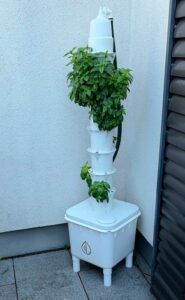 A quick bit of context before we get to the experience report: the HydraTower is a vertical system where plants sit stacked on top of one another in a column, rather than side by side across a flat bed. That saves space, which makes it a great fit for a balcony, patio, or indoors. Water circulates automatically through the system, delivering water and nutrients straight to the roots, with no soil involved at all.
The big advantage over traditional gardening: you’re no longer tied to soil, weather, or season. With a stable system, you can harvest outdoors or indoors almost regardless of the time of year.
The mechanics behind it are simple. Water flows down through the tower, and at the top a venturi nozzle draws in air, adding oxygen to the water automatically, no extra equipment required. That means the roots get everything they need, water, nutrients and oxygen, in a single pass.
Life with the tower: a first-hand account
Enough theory, here’s the good part. Our user has been running their HydraTower for a while now and gave us some honest insight into just how much upkeep it actually takes.
From seed to leafy jungle
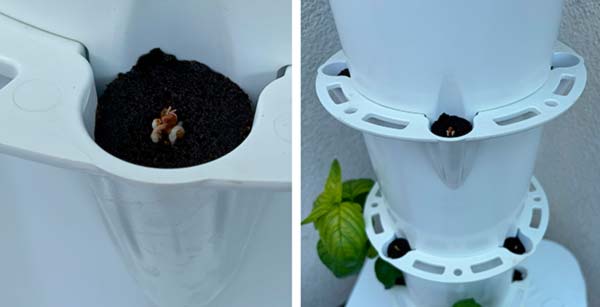
Everything starts small: a seed in a moist growing sponge, tucked into an opening in the tower. From there, the system takes over.
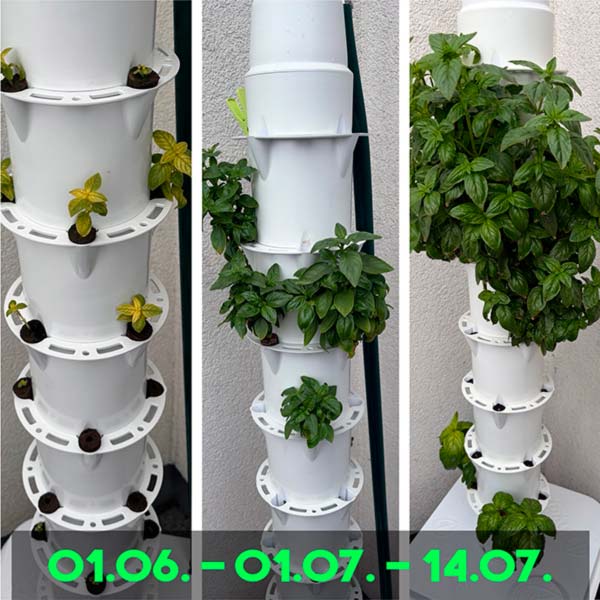
Just how fast that turns into a lush basil bush is shown quite strikingly over a six-week comparison: in early June, only a few delicate seedlings sit in the openings; by early July, sturdy shoots are already winding their way around the tower; and by mid-July, the upper half of the tower has completely disappeared under dense basil growth